Introduction
Few novels have given the English language as many instantly recognizable ideas as George Orwell’s Nineteen Eighty-Four. Published in 1949, the novel introduced or popularized concepts such as Big Brother, Newspeak, thoughtcrime, doublethink, and Room 101.
The most valuable 1984 quotes are not memorable merely because they sound dramatic. They matter because Orwell uses them to explore what happens when a government attempts to control language, memory, information, identity, love, and reality itself.
Below, you’ll find a reader-friendly guide organized around the major ideas and characters in the novel.
Editorial note: Direct quotations are kept brief and selectively used for identification and analysis. The original reflections throughout this guide are written specifically for this article and should not be mistaken for quotations by Orwell.
Famous 1984 Quotes
These are the lines and ideas most strongly associated with Orwell’s dystopian masterpiece. Goodreads’ large reader-generated quotation collection also shows how frequently readers return to themes such as truth, history, freedom, secrecy, and power.
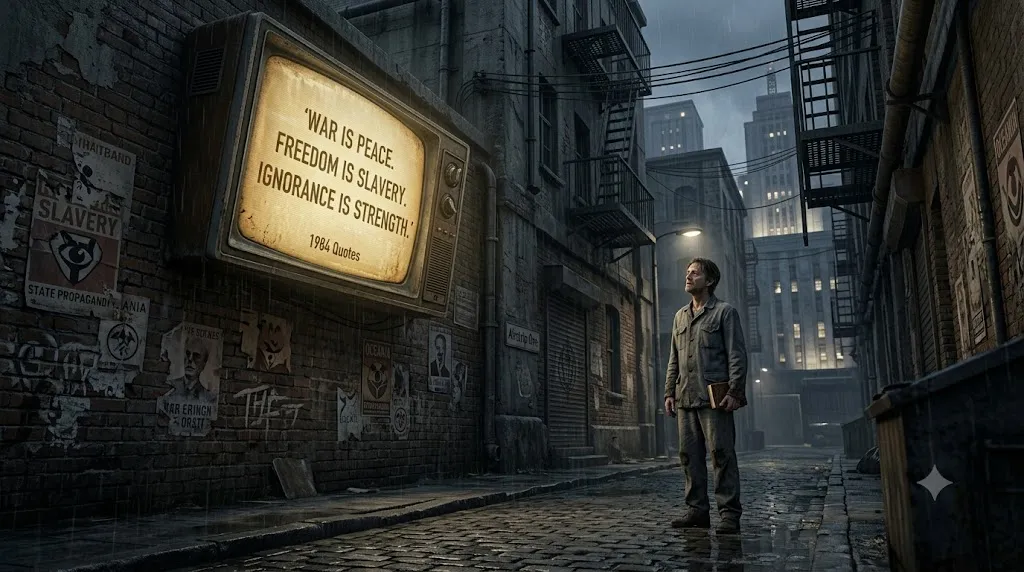
A famous short excerpt: “War is peace. Freedom is slavery. Ignorance is strength.”
The Party’s slogans are memorable because each statement deliberately contradicts ordinary logic.
15 original shareable reflections inspired by the theme
- A slogan becomes dangerous when people stop questioning it.
- The loudest message is not always the truest one.
- Contradictions become powerful when fear makes them believable.
- Propaganda rarely asks permission before entering everyday life.
- A repeated lie can begin to feel strangely familiar.
- The most frightening words are sometimes the simplest ones.
- Truth becomes fragile when nobody is allowed to preserve it.
- A society can lose freedom one unquestioned idea at a time.
- The mind needs room to disagree.
- Powerful slogans often hide powerless questions.
- When language changes, perception can change with it.
- A memorable phrase can carry an entire political warning.
- Orwell’s sharpest lines turn abstract power into something visible.
- The best dystopian writing makes readers question ordinary reality.
- Some sentences survive because their warning never becomes irrelevant.
1984 Quotes About Truth
Truth is one of the novel’s central battlegrounds. Winston’s work at the Ministry of Truth requires him to alter historical records so that the Party’s present version of events appears consistent. The Orwell Foundation identifies this manipulation of history and reality as one of the novel’s defining ideas.
A famous short excerpt associated with this theme is: “Who controls the past controls the future.”
15 original shareable reflections
- Truth loses power when nobody remembers yesterday.
- Controlling history is another way of controlling possibility.
- A fact cannot defend itself if every record disappears.
- Memory becomes political when the past can be rewritten.
- Truth requires more than belief; it requires evidence.
- Forgetting can sometimes be as powerful as lying.
- Whoever edits the record can influence the story people inherit.
- Reality becomes unstable when yesterday has no permanent version.
- A society without reliable memory becomes easier to manipulate.
- Truth is strongest when people are free to verify it.
- The past should not change merely because power changes its mind.
- Facts become dangerous when they contradict authority.
- Historical memory can be a form of resistance.
- A rewritten past creates a carefully controlled present.
- Orwell makes truth feel like something worth defending.
1984 Quotes About Freedom
Freedom in 1984 is not simply about movement. Orwell examines the deeper freedom to think, remember, love, speak, and recognize reality independently.
The Party’s famous slogan deliberately reverses the ordinary meaning of freedom: “Freedom is slavery.”
15 original shareable reflections
- Freedom begins with the ability to question.
- A free mind cannot be completely Programmed.
- Physical freedom means little without intellectual freedom.
- Choosing what to believe is part of being human.
- Freedom disappears quietly when curiosity becomes dangerous.
- The right to disagree protects the right to think.
- Independent thought is powerful because it cannot be centrally scheduled.
- A person can be surrounded by choices and still lack freedom.
- Fear can build invisible walls around the mind.
- Freedom needs memory, language, and courage.
- The ability to say “I disagree” is surprisingly valuable.
- Real freedom cannot depend entirely on official approval.
- A controlled vocabulary can create controlled possibilities.
- The first rebellion may happen inside someone’s thoughts.
- Freedom becomes visible when someone refuses to pretend.
1984 Quotes About Power and Control
Orwell’s Party does not seek power merely to accomplish a political objective. It seeks power as an end in itself. The Orwell Foundation highlights this chilling dimension through O’Brien’s famous formulation that “the object of power is power.” (The Orwell Foundation)
15 original shareable reflections
- Power becomes frightening when accountability disappears.
- Control becomes stronger when people begin policing themselves.
- The ultimate authority wants obedience without explanation.
- Power over behavior is temporary; power over belief is deeper.
- Fear is an efficient tool when trust has disappeared.
- A government that controls information can influence decisions.
- Control becomes invisible when it feels normal.
- The strongest prison may not require physical walls.
- Authority becomes dangerous when questioning becomes disloyalty.
- Power can reshape reality when institutions control the record.
- The desire for control rarely stops at controlling actions.
- Psychological domination can outlast physical punishment.
- The Party’s greatest weapon is not merely force.
- Control becomes complete when resistance feels impossible.
- Orwell asks what happens when power has no natural limit.
1984 Quotes About Big Brother
Big Brother is perhaps the most recognizable symbol from 1984. The Orwell Foundation specifically notes Big Brother among the novel’s concepts that entered everyday language.
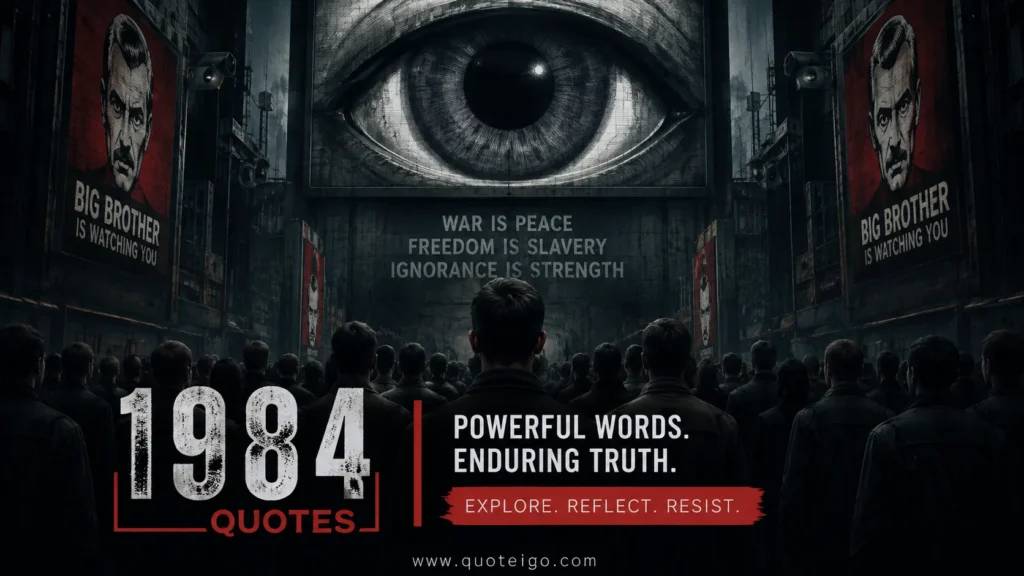
The familiar warning “Big Brother is watching you” captures the atmosphere of permanent observation.
15 original shareable reflections
- Surveillance changes behavior even when nobody knows who is watching.
- Big Brother represents authority made permanently visible.
- An image can create fear without saying much.
- Being watched can become a form of psychological control.
- The frightening part is not knowing when observation happens.
- Privacy becomes precious when surveillance becomes ordinary.
- A watching symbol can become a warning before punishment arrives.
- Big Brother turns political authority into a personal presence.
- Constant observation encourages people to censor themselves.
- The fear of being seen can control what remains unseen.
- Surveillance works best when people expect it everywhere.
- Big Brother is powerful partly because the symbol never sleeps.
- Watching is not the same as understanding.
- A society can become obedient without every citizen being arrested.
- The idea of being watched can become its own prison.
1984 Quotes About Surveillance
The novel’s surveillance system is built around telescreens, observation, informants, and the Thought Police. LitCharts’ chapter-by-chapter quotation material repeatedly connects Winston’s life with the fear that his actions and even expressions may be observed.
15 original shareable reflections
- Surveillance changes people before it catches anyone.
- Privacy matters most when it becomes uncertain.
- Being watched can change how honestly people behave.
- A camera cannot read every thought, but fear can.
- The possibility of observation can be enough.
- Surveillance becomes powerful when citizens internalize it.
- Privacy gives people space to develop private opinions.
- Constant monitoring turns ordinary behavior into performance.
- The watched person eventually becomes their own censor.
- Observation without accountability creates a dangerous imbalance.
- Technology can watch behavior, but fear shapes meaning.
- A monitored society can make silence feel safer than honesty.
- The absence of privacy can weaken individuality.
- Surveillance is most effective when people expect consequences.
- Orwell’s warning is ultimately about power, not gadgets.
1984 Quotes About War
War in 1984 is inseparable from propaganda and political control. The Party uses perpetual conflict to maintain fear, loyalty, scarcity, and ideological discipline.
The slogan “War is peace” is one of the novel’s most famous examples of political contradiction.
15 original shareable reflections
- War can become political theater when citizens never see the whole picture.
- Fear of an enemy can unite people behind authority.
- Perpetual conflict makes emergency feel permanent.
- Propaganda can turn distant violence into daily emotion.
- A permanent enemy makes permanent control easier to justify.
- War language can simplify complicated political realities.
- When peace feels impossible, obedience can feel necessary.
- The Party benefits from a world that never feels stable.
- Conflict can distract people from problems inside their own society.
- War becomes useful propaganda when facts become uncertain.
- An enemy can be powerful even when its story keeps changing.
- Political fear thrives on uncertainty.
- Orwell connects war with manipulation rather than heroism.
- The novel asks who benefits when conflict never ends.
- Peace becomes difficult to imagine when war becomes normal.
1984 Quotes About Love
Love is especially important because Winston and Julia’s relationship becomes an attempt to reclaim something private from the Party.
Their relationship shows that political control reaches beyond laws and workplaces and into the most intimate parts of human life.
15 original shareable reflections
- Private affection becomes rebellious when privacy is forbidden.
- Love gives Winston something the Party cannot easily define.
- Human connection can challenge political isolation.
- Intimacy becomes dangerous when the state wants emotional loyalty.
- Love creates a private world inside a public dictatorship.
- Trust becomes courageous when betrayal is expected.
- Romance can become resistance when every relationship is monitored.
- The Party fears private loyalty because it competes with political loyalty.
- Human beings need connection even under pressure.
- Love can create courage before it creates certainty.
- Private happiness can become politically significant.
- A secret relationship can represent a secret identity.
- Orwell shows how power tries to invade emotional life.
- Love matters in the novel because it represents personal freedom.
- The tragedy is not only losing a relationship but losing oneself.
1984 Quotes About Fear
Fear is one of the Party’s most effective instruments. Punishment does not merely discourage resistance; it attempts to transform the individual’s understanding of reality.
15 original shareable reflections
- Fear can make impossible obedience feel reasonable.
- The threat of punishment can control more people than punishment itself.
- Fear teaches people to hide before anyone tells them to.
- A frightened society becomes easier to organize from above.
- The Party understands that fear reaches deeper than anger.
- Fear can make people betray their own principles.
- Psychological pressure can be stronger than physical force.
- The most personal fears can become political weapons.
- Fear changes what people are willing to remember.
- Courage becomes meaningful only when fear is present.
- A person may resist authority until fear becomes personal.
- Fear narrows choices before anyone officially removes them.
- The Party’s greatest victories happen inside the mind.
- Fear can make truth feel more dangerous than falsehood.
- Orwell’s darkest warning is about fear changing identity.
1984 Quotes About Reality and Memory
Reality in 1984 is not treated as something completely independent of human perception. The Party attempts to control records, language, information, and ultimately the individual’s ability to trust their own memory.
The Orwell Foundation describes the novel as a warning about the fragility of objective knowledge and the manipulation of historical memory.
15 original shareable reflections
- Memory is personal evidence until someone teaches you to distrust it.
- Reality becomes vulnerable when records can be rewritten.
- Forgetting can be politically useful.
- A person who doubts every memory becomes easier to control.
- History gives people a reference point outside the present.
- Without memory, contradiction becomes difficult to prove.
- Reality should not depend entirely on whoever holds authority.
- The past gives people a standard for judging the present.
- Erasing evidence makes falsehood harder to challenge.
- Memory can preserve identity when Institutions try to erase it.
- The ability to remember is also the ability to compare.
- Truth becomes fragile when personal experience is dismissed.
- Reality requires more than whatever authority announces.
- Orwell makes memory part of the struggle for freedom.
- A society without trustworthy history loses its compass.
1984 Quotes About Propaganda
Propaganda is not simply misinformation in Orwell’s world. It is a complete system for shaping what people notice, remember, fear, celebrate, and believe.
The novel’s Ministry of Truth is deliberately named to represent its opposite function: Winston works there altering records to match the Party’s current position.
15 original shareable reflections
- Propaganda works best when it becomes ordinary.
- A constant stream of information can still hide the truth.
- Repetition can make a claim feel more familiar than factual.
- Propaganda does not always sound angry; sometimes it sounds comforting.
- Controlling the story can influence how people interpret events.
- The strongest propaganda often mixes truth with omission.
- Fear and propaganda can reinforce one another.
- A manufactured enemy can simplify complicated problems.
- Information loses value when its history cannot be verified.
- Propaganda can turn uncertainty into certainty overnight.
- Political language can make harmful actions sound respectable.
- The audience matters as much as the message.
- Propaganda succeeds when people stop asking who created it.
- Critical thinking is a defense against manufactured certainty.
- Orwell shows that controlling information can become controlling reality.
1984 Quotes About Newspeak and Language
Newspeak is one of Orwell’s most influential ideas. Syme explains that its purpose is to narrow the range of thought by reducing the language available for expressing forbidden ideas.
15 original shareable reflections
- Language gives thoughts somewhere to live.
- Remove enough words and some ideas become harder to express.
- Clear language makes unclear intentions easier to expose.
- Euphemisms can hide uncomfortable realities.
- Vocabulary influences how precisely people can think.
- Political language can become a shield against accountability.
- Simplifying language is not always the same as improving it.
- Words can preserve memories that power would rather erase.
- A society needs language capable of disagreement.
- Losing words can mean losing distinctions between ideas.
- Honest language makes manipulation harder.
- The Party fears language because language can preserve independent thought.
- Newspeak is control disguised as efficiency.
- A smaller vocabulary can create a smaller intellectual landscape.
- Orwell makes language part of the battle for reality.
1984 Quotes About Rebellion and Individuality
Winston’s rebellion begins privately. His diary, memories, forbidden thoughts, relationship with Julia, and desire to understand the past all represent attempts to preserve an individual identity.
15 original shareable reflections
- Rebellion can begin with one private question.
- Individuality survives through choices that authority cannot completely script.
- Keeping a personal record can become an act of resistance.
- Curiosity can be the first crack in ideological certainty.
- A private thought can feel revolutionary under total control.
- Rebellion does not always begin with shouting.
- Sometimes resistance begins by refusing to pretend.
- Individual identity requires some private space.
- Remembering differently can challenge an official story.
- A person becomes dangerous to authoritarian power when they think independently.
- Rebellion requires more than anger; it requires conviction.
- Winston’s struggle is ultimately a struggle over his own mind.
- Individuality becomes precious when conformity is mandatory.
- The Party fears independent identity because it cannot fully own it.
- Resistance matters even when the odds seem impossible.
Winston Smith Quotes and Ideas
Winston is the emotional center of 1984. He is not a traditional heroic figure; he is frightened, conflicted, lonely, curious, and deeply aware of his own vulnerability.
That complexity makes his observations especially important.
15 original shareable reflections inspired by Winston
- Winston wants truth even when truth terrifies him.
- His rebellion begins with dissatisfaction rather than certainty.
- He understands that memory can challenge official history.
- His diary becomes a private space for forbidden honesty.
- Winston is courageous, but never fearless.
- His curiosity repeatedly pulls him toward danger.
- He wants connection in a world designed to isolate people.
- His relationship with Julia gives rebellion an emotional dimension.
- Winston’s greatest weakness is his belief that someone else may save him.
- His questions are more dangerous than his actions.
- Winston represents the ordinary person confronting extraordinary control.
- His story shows how difficult Independent thinking can become.
- He is searching for evidence that reality exists outside propaganda.
- Winston’s tragedy is partly the destruction of personal certainty.
- His story remains memorable because his fear feels human.
O’Brien and Julia: Two Very Different Forms of Resistance
O’Brien and Julia represent radically different forces in Winston’s story. Julia is practical and personal in her rebellion, while O’Brien becomes the Party’s intellectual and psychological instrument.
The contrast is essential to understanding the novel’s treatment of power.
15 original shareable reflections
- Julia’s rebellion begins with personal freedom.
- O’Brien understands power at a philosophical level.
- Julia wants moments of freedom; O’Brien wants control of the mind.
- Their approaches reveal different meanings of resistance.
- Julia distrusts ideology but understands practical survival.
- O’Brien uses intellectual confidence as a weapon.
- Julia represents private rebellion.
- O’Brien represents institutional power.
- One seeks freedom through experience; the other seeks obedience through manipulation.
- Their contrast exposes the Party’s psychological sophistication.
- Resistance can be emotional, intellectual, or physical.
- O’Brien understands Winston’s hopes well enough to exploit them.
- Julia’s rebellion is grounded in ordinary human desire.
- O’Brien’s power comes from making domination sound logical.
- Together they reveal the novel’s central conflict: individuality versus control.
The Most Important 1984 Quotes Explained
The best way to understand Orwell’s quotations is to connect each memorable line to the larger system of ideas surrounding it.
| Quote idea | Main theme | Why it matters |
| Party slogans | Doublethink | Contradiction becomes official truth |
| Controlling the past | History | Whoever controls records can shape memory |
| Big Brother | Surveillance | Authority becomes permanently visible |
| Newspeak | Language | Vocabulary becomes a tool of control |
| Two plus two | Reality | Independent evidence conflicts with authority |
| Thoughtcrime | Individuality | Private thinking becomes politically dangerous |
| Power for its own sake | Authority | Control becomes an objective rather than a means |
| Room 101 | Fear | Personal terror becomes a mechanism of obedience |
The Orwell Foundation similarly emphasizes truth, language, memory, doublethink, and political power as central to understanding the novel.
Why 1984 Quotes Still Matter Today
1984 remains relevant not because every detail of Orwell’s fictional future came true, but because the novel explores mechanisms of power that readers can recognize in many different contexts.
Its vocabulary has become part of everyday discussion. Orwellian, Big Brother, Newspeak, doublethink, thoughtcrime, and Room 101 are now widely understood beyond the novel itself.
The book’s continuing value comes from its questions:
- Who controls information?
- Can people recognize manipulation?
- What happens when historical records become unreliable?
- How does language influence thought?
- How much privacy does an individual need?
- Why do people obey powerful institutions?
- What happens when political loyalty becomes more important than truth?
Those questions make Orwell’s quotations useful for literary study, essays, classroom discussion, book clubs, and thoughtful social posts.
Quick Guide: Which 1984 Quote Theme Should You Choose?
| If you need a quote about… | Explore |
| Truth | Truth & Reality |
| Freedom | Freedom |
| Government control | Power & Control |
| Surveillance | Big Brother & Surveillance |
| History | Memory & Reality |
| Propaganda | Propaganda |
| Language | Newspeak |
| Rebellion | Individuality |
| Romance | Love |
| Fear | Fear |
| War | War |
| Winston | Winston Smith |
| Psychological control | O’Brien |
This organization also creates a better search experience than forcing every visitor through one enormous chronological list.
People Also Ask
Ans: One of the most recognizable is the Party’s contradictory slogan: “War is peace. Freedom is slavery. Ignorance is strength.” It captures the novel’s concept of doublethink and the Party’s manipulation of language
Ans: The famous phrase is “Big Brother is watching you.” It establishes the novel’s atmosphere of surveillance and political intimidation.
Ans: It means that controlling historical records can influence how people understand the present and imagine the future. In 1984, the Party continually changes records to maintain its version of reality.
Ans: The novel presents freedom as more than physical independence. It includes the ability to think, remember, speak, form relationships, and recognize reality independently.
Ans: The novel portrays truth as vulnerable when a powerful institution controls information, historical records, language, and public discussion.
Conclusion
George Orwell’s Nineteen Eighty-Four remains powerful because its ideas extend far beyond a fictional dystopian society. Through unforgettable lines, Orwell examines how easily individual thought can be threatened when authority controls information and reality.
The most meaningful 1984 quotes are not simply famous words to collect. They are ideas that reveal how the Party maintains control over Winston and the people of Oceania. From Big Brother and Newspeak to doublethink, thoughtcrime, and the rewriting of history, each concept adds another layer to Orwell’s warning about unchecked power.
Whether you are a student analyzing the novel, a reader exploring Orwell’s themes, or someone searching for a memorable quote about truth and freedom, understanding the speaker, context, theme, and meaning makes every quotation more valuable.
Ultimately, 1984 reminds us that protecting truth requires more than remembering facts. It requires the freedom to question, think independently, preserve history, and recognize manipulation. That is what makes Orwell’s words—and the lessons behind them—continue to matter decades after the novel was published.